
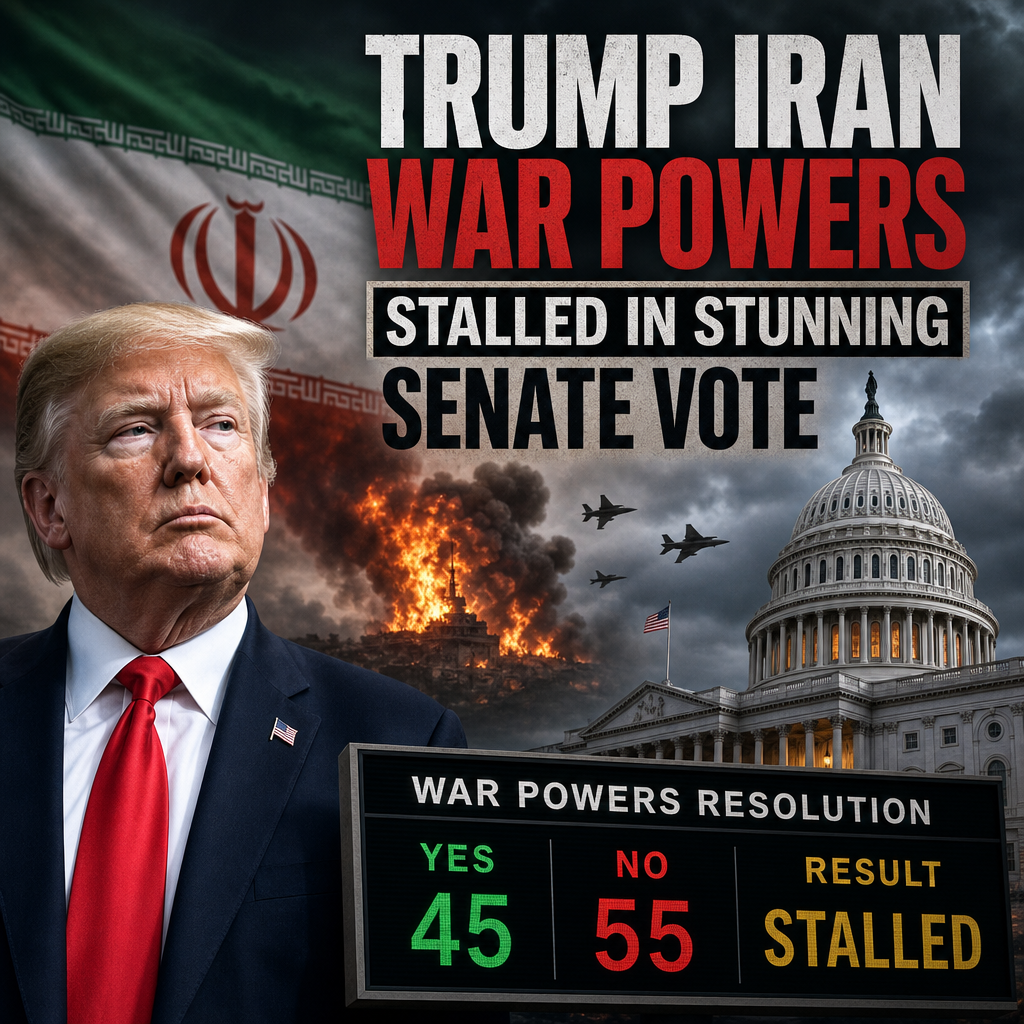
Trump Iran War Powers Stalled in Stunning Senate Vote


Trump Iran war powers became a flashpoint again after a Senate vote failed to advance a resolution aimed at limiting presidential authority to take military action against Iran, underscoring how deeply divided Washington remains over the balance between Congress and the White House on matters of war.
The outcome was striking not only because of the issue itself, but because it revealed how hard it remains for lawmakers to turn broad concerns about executive overreach into binding action. Supporters of the resolution argued that any major strike on Iran should require explicit congressional approval. Opponents, meanwhile, warned that too rigid a constraint could hamper the president’s ability to respond quickly to threats in a volatile region.



The vote did not happen in a vacuum. It came amid broader fears of escalation in the Middle East, where tensions involving Iran, U.S. forces, Israel, and regional armed groups have repeatedly threatened to spiral. News coverage across outlets reflected that complexity: some emphasized constitutional questions and war powers limits, while others stressed the practical security risks of signaling hesitation to Tehran.
Trump Iran war powers and the constitutional fight
At its core, the dispute is about who gets to decide when the United States goes to war. Congress holds the power to declare war, but presidents have increasingly relied on their commander-in-chief authority and existing authorizations to justify military action without new legislative approval.




That tension has become especially acute with Iran. Lawmakers skeptical of military escalation argue that the country is too important, and any strike too consequential, to be left to unilateral executive action. They see war powers resolutions as a needed reminder that the Constitution was designed to prevent a single leader from dragging the nation into conflict on short notice.
The case against the resolution was equally blunt. Critics said Washington should avoid boxing in a president facing an unpredictable adversary. In their view, a public restriction could weaken deterrence and telegraph restraint in moments when ambiguity itself can be a strategic asset.
This is where the Senate stalemate matters. The chamber did not simply reject the idea of restraint; it showed how difficult it is to create a bipartisan consensus around war powers when party loyalty, national security politics, and executive branch prerogatives collide.
Why the Senate vote mattered beyond symbolism
The immediate vote may not have changed the military balance, but its political meaning was considerable. For supporters, even forcing the issue onto the floor was a way to assert congressional relevance. For opponents, the failure of the measure suggested that the current framework still gives presidents wide latitude to act.
Several themes emerged clearly from coverage by different outlets:
– Democratic lawmakers and peace advocates framed the measure as a constitutional check on presidential war-making.
– Republican opponents generally emphasized deterrence, operational flexibility, and the risk of constraining U.S. power.
– International coverage focused more on the chance of escalation and the broader regional stakes if tensions with Iran worsen further.
Sky News-style reporting on the issue tended to place the Senate vote within the wider strategic picture: a U.S. domestic argument with potentially international consequences. Al Jazeera’s coverage of similar Iran-related developments has often highlighted the human and regional cost of escalation, along with skepticism from critics who see U.S. military policy as too quick to lean on force. RT, by contrast, has historically leaned into themes of American political dysfunction and anti-war sentiment, often portraying such votes as evidence that Washington is divided and uncertain about the use of power.
That mix of angles helps explain why the vote drew attention well beyond Capitol Hill. To some observers, it was proof that Congress still wants a say. To others, it showed that when the stakes are high, the Senate often defaults to preserving presidential flexibility.
What the split says about U.S. policy on Iran
The larger lesson is that the U.S. still lacks a durable, clearly enforced framework for handling military confrontation with Iran. Administrations of both parties have relied on broad interpretations of presidential power, while Congress has often preferred symbolic pushback over final confrontation.
That pattern creates a recurring contradiction. Lawmakers may privately fear that a new conflict with Iran would be catastrophic, but many are reluctant to vote for measures that could be portrayed as weakening the president in a crisis. As a result, war powers debates can become exercises in principle more than in policy.
There is also a strategic downside to this ambiguity. If Tehran concludes that the U.S. political system is too divided to sustain a coherent response, deterrence could be weakened. Yet if Congress never asserts its authority, the constitutional guardrails around war-making continue to erode. Neither outcome is ideal.
In that sense, the Senate vote was not just about one resolution. It reflected a deeper unresolved question: how much power should any president have to escalate a confrontation with Iran, especially when the consequences could reach far beyond the Middle East?
A narrow vote, a wide uncertainty
The most honest conclusion is that the Senate’s failure to advance the measure does not settle the war powers issue at all. It leaves intact a system in which presidents retain broad room to act, while Congress retains the ability to object after the fact.
That may be politically convenient, but it is hardly reassuring. If the point of war powers limits is to prevent rash or unilateral decisions, then the debate is far from over. And if the point is to preserve freedom of action in an unpredictable crisis, then the Senate’s reluctance makes sense.
What the vote ultimately revealed is not consensus, but caution, division, and a familiar institutional drift: when confronted with the possibility of conflict with Iran, Washington still struggles to choose between restraint and readiness.


























